Ask any American who went to elementary school in the past 50 years about the Great Wall of China, and chances are they'll confidently tell you it's the only man-made structure visible from space. It's one of those "facts" that feels impressive enough to remember and share.
There's just one problem: it's completely false. And we've known it's false for decades.
Astronauts Keep Trying to Correct the Record
NASA astronauts have been debunking this myth since the 1960s. When the first American astronauts returned from space, reporters asked them about seeing the Great Wall. Their response? They couldn't see it at all.
In 2003, China sent its first astronaut, Yang Liwei, into space. Before his mission, Chinese media excitedly anticipated that he would finally confirm their national monument's visibility from orbit. Instead, Yang Liwei returned with disappointing news: "I didn't see the Great Wall," he told reporters.
Even more definitively, Canadian astronaut Chris Hadfield, who spent months on the International Space Station and became famous for his detailed Earth photography, has stated flatly: "The Great Wall of China is not visible from orbit with the naked eye. It's too narrow, and it follows the natural contours and colors of the landscape."
The Physics Problem
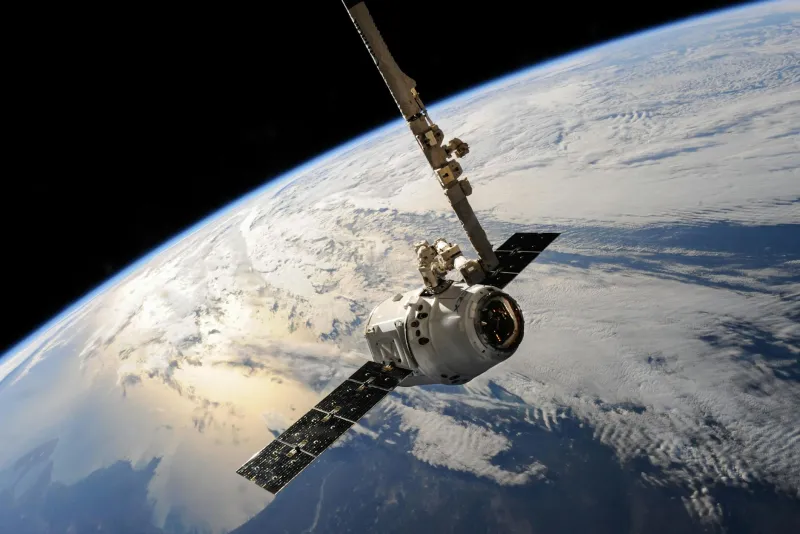
The Great Wall myth fails basic optical principles. At its widest points, the wall is about 30 feet across. From the International Space Station's altitude of roughly 250 miles, that's like trying to spot a piece of dental floss from a distance of two miles.
Moreover, the wall was built using local materials and designed to blend with the surrounding landscape for defensive purposes. From space, it's virtually indistinguishable from the natural ridgelines it follows.
For comparison, major highways are much wider than the Great Wall and built with materials specifically designed to be visible. Yet even six-lane interstate highways are barely discernible from space without magnification.
Tracing the Myth to Its Source
So where did this persistent falsehood come from? The earliest known reference appears in a 1932 "Ripley's Believe It or Not" column, which claimed the wall was "the mightiest work of man—the only one that would be visible to the human eye from the moon."
Note that Ripley originally said "from the moon"—which is even more ridiculous than the space station version. The moon is roughly 1,000 times farther from Earth than the space station. From that distance, entire countries are barely visible as distinct features.
The claim evolved over time, with "from the moon" gradually becoming "from space" as the Space Age began and the distinction between lunar distance and low Earth orbit got blurred in popular understanding.
Why Feel-Good National Myths Persist
The Great Wall myth endures because it serves a psychological function beyond simple factual information. It makes the structure seem even more impressive—so massive and significant that it transcends earthly scale.
For Americans, the myth often gets taught alongside other "amazing facts" about world cultures, reinforcing the idea that the Great Wall represents something uniquely magnificent about Chinese civilization. For Chinese people, the myth provides national pride—their ancestors built something so incredible that it's visible from space.
When myths serve these emotional purposes, corrections feel almost beside the point. The "fact" isn't really about optics or engineering; it's about wonder and cultural significance.
The Classroom Echo Chamber
Perhaps most frustratingly, the myth continues spreading through American educational materials despite decades of debunking. Textbook publishers apparently find it easier to repeat familiar content than to fact-check and update their materials.
Teachers who learned the "fact" as children now pass it along to their students, creating a self-perpetuating cycle. When a teacher confidently states something in a classroom, students rarely think to question it—especially when it sounds impressively factual.
This creates what researchers call "the illusion of knowledge"—information that feels true because we've heard it repeated by authority figures, even when it contradicts available evidence.
What You Can Actually See From Space
So what human-made features are visible from space? Astronauts report seeing large cities at night (because of their light pollution), major airports (because of their distinctive shapes and bright concrete), and some massive industrial complexes.
During the day, the most visible human-made features are actually agricultural—the geometric patterns of large-scale farming create stark contrasts with natural landscapes that show up clearly from orbit.
Ironically, some of the most visible human impacts on the planet are also the least impressive: deforestation patterns, mining operations, and urban sprawl. These might not sound as romantic as ancient architectural wonders, but they're what actually shows up when you're looking down at Earth from 250 miles up.
Moving Beyond the Myth
The Great Wall of China is genuinely remarkable—it's an incredible feat of engineering, organization, and human determination that stretches over 13,000 miles. It doesn't need to be visible from space to be impressive.
Maybe it's time we appreciated the wall for what it actually is: an amazing example of human ingenuity that's perfectly visible from where it was meant to be seen—right here on Earth, where the people who built it lived and worked.
The next time someone confidently shares this "fact," you'll know the real story. And maybe, just maybe, we can finally put this 90-year-old myth to rest.