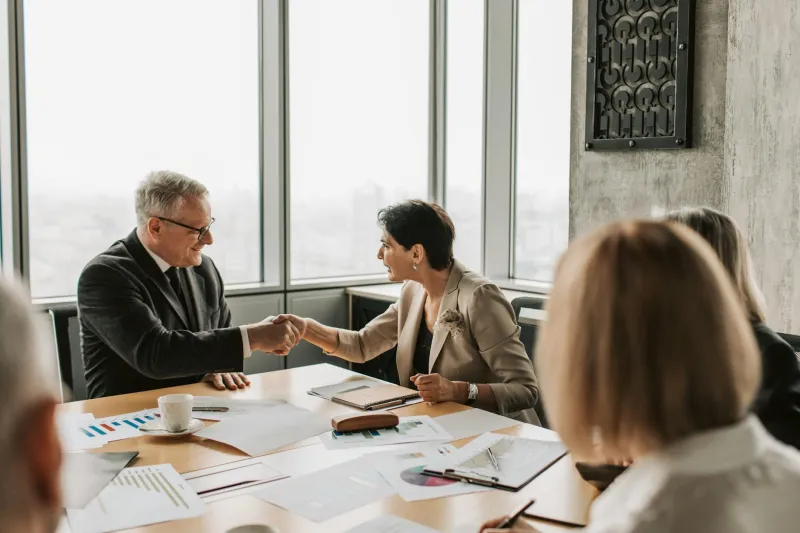
Every business deal, job interview, and networking event in America begins the same way: with a handshake. We're taught that a firm grip conveys confidence, that the gesture builds trust, and that it's been a symbol of goodwill for thousands of years.
That last part is where the story gets interesting — and a lot less warm and fuzzy than business etiquette books suggest.
The Medieval Reality Behind Modern Manners
The most credible historical evidence points to the handshake emerging in medieval Europe as a practical security measure. When strangers met, especially for trade or negotiation, the primary concern wasn't building rapport — it was not getting killed.
 Photo: Medieval Europe, via cunninghistoryteacher.org
Medieval weapons were typically carried in the right hand or concealed in the right sleeve. Extending your right hand, palm open, demonstrated that you weren't holding a blade. Grasping the other person's right hand prevented them from quickly drawing a weapon. The up-and-down shaking motion helped reveal anything hidden in loose sleeves.
Contemporary accounts from medieval merchants describe handshakes lasting much longer than modern versions — sometimes 30 seconds or more — while both parties assessed whether the other posed a threat. The gesture wasn't about friendship; it was about survival.
How Business Schools Rewrote History
The transformation of the handshake from weapon check to trust ritual happened gradually over centuries, but accelerated dramatically in 20th-century America as business education formalized.
Dale Carnegie's "How to Win Friends and Influence People," published in 1936, popularized the idea that handshakes were primarily about making good impressions. Business schools began teaching handshake techniques as part of professional development curricula, emphasizing eye contact, firmness, and duration.
This reframing served a practical purpose for modern commerce. Telling salespeople and executives that handshakes were ancient trust-building rituals was more useful than explaining that they originally existed to prevent stabbings. The medieval reality didn't exactly fit the image business culture wanted to project.
The Anthropological Evidence Gets Complicated
Some researchers point to even earlier origins, noting that primates engage in similar gestures when establishing non-aggressive contact. Ancient Greek and Roman art occasionally depicts handshake-like greetings, though these appear to be ceremonial rather than routine social interactions.
However, the widespread use of handshakes as standard greetings — the version Americans know today — is relatively recent. Most cultures developed different greeting customs based on their specific security concerns and social structures.
Bowing cultures like Japan kept hands visible but avoided physical contact that could be interpreted as aggressive. Middle Eastern cultures often placed hands over hearts to show peaceful intentions without creating vulnerability through extended contact.
What the Pandemic Revealed About Inherited Gestures
COVID-19 provided an unexpected experiment in how deeply embedded the handshake reflex really is. Despite widespread knowledge that hand contact spread disease, many Americans struggled to suppress the automatic urge to extend their hand when meeting someone new.
Business meetings became awkward as participants caught themselves mid-gesture, unsure how to begin interactions without their standard ritual. Some companies tried implementing alternative greetings — elbow bumps, waves, verbal acknowledgments — but most felt forced and uncomfortable.
The difficulty of abandoning handshakes revealed how thoroughly the gesture had become integrated into American social and business culture, even though most people couldn't explain why it felt necessary.
The Global Handshake Economy
Today's international business world has largely standardized on the American-style handshake, regardless of local customs. A Japanese executive meeting American clients will likely shake hands rather than bow. An Indian businessperson might abandon the traditional namaste greeting in favor of Western handshaking.
This standardization creates interesting power dynamics. Cultures that historically used different greeting methods are expected to adapt to handshake norms when engaging in global commerce. The gesture that once checked for weapons now serves as a marker of participation in Western business culture.
Investment firms, law offices, and corporate boardrooms across America still begin major financial transactions with handshakes, often followed by elaborate signing ceremonies and legal documentation. The irony is palpable: billion-dollar deals start with a ritual designed to ensure the participants weren't planning to murder each other.
The Psychology of Physical Contact in Business
Modern research does support some aspects of handshake mythology. Brief physical contact can release oxytocin, sometimes called the "trust hormone," which may make subsequent negotiations more cooperative. Studies show that business interactions beginning with handshakes often result in more favorable outcomes for both parties.
However, this effect appears to work regardless of the historical meaning behind the gesture. The same benefits occur with other forms of brief, appropriate physical contact — suggesting that the handshake's power comes from human biology rather than its specific cultural significance.
The medieval origins don't negate the modern effects, but they do reframe them. The handshake works as a business tool not because of ancient wisdom about trust-building, but because humans are generally wired to respond positively to non-threatening physical contact.
When Security Meets Etiquette
The weapon-checking origins of handshakes created some customs that persist today without anyone remembering why. The preference for right-handed handshakes, the importance of maintaining eye contact during the gesture, and the social awkwardness of refusing to shake hands all trace back to medieval security concerns.
Even the business advice about matching the other person's grip strength has historical roots. In medieval contexts, an overly aggressive handshake could be interpreted as a threat, while a weak grip might suggest you were concealing something or preparing to flee.
The Takeaway for Modern Deal-Making
Understanding the handshake's real origins doesn't diminish its current utility, but it does provide useful perspective. The gesture Americans use to begin business relationships wasn't designed to build trust — it was designed to prevent violence between strangers who had good reason to be suspicious of each other.
That's actually a more honest foundation for business dealings than the friendship mythology suggests. Most commercial relationships do begin with mutual wariness, careful assessment, and the need to establish that neither party intends harm to the other.
The next time you're shaking hands to close a deal, remember that you're participating in a ritual that's fundamentally about managing risk between people who don't know each other well. In that context, it might be the most appropriate way to begin a business relationship after all.
Just don't mistake it for ancient wisdom about human connection. Sometimes the most practical explanation is the right one.