The 'Most of Your Genes Are Silent' Story Is Outdated — Here's What's Actually Happening in Your Cells
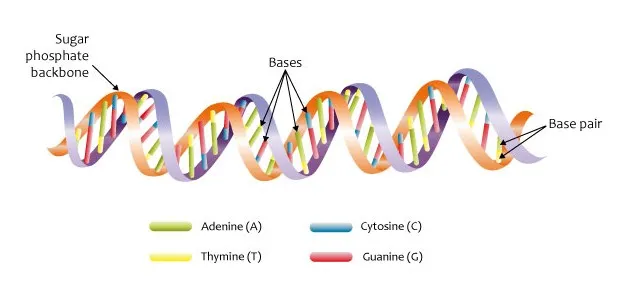
Photo: Genomics Education Programme, CC BY 2.0, via Wikimedia Commons
The 'Most of Your Genes Are Silent' Story Is Outdated — Here's What's Actually Happening in Your Cells
Science communication has a recurring problem: it loves a clean fraction. Ten percent of your brain. Five percent of the ocean. And somewhere along the way, a version of that instinct attached itself to genetics — the idea that most of your genes are switched off, sitting quietly in your DNA while only a small, elite crew does the real work.
It's an appealing picture. It implies untapped potential, hidden complexity, maybe even a biological frontier waiting to be unlocked. It's also a significant oversimplification of how gene expression actually works — and genomics researchers have been quietly updating the story for years.
What the 'Inactive Gene' Idea Actually Meant
The original claim wasn't entirely invented. It emerged from a real observation: at any given moment, in any given cell, only a subset of your roughly 20,000 protein-coding genes are actively being read and translated into proteins. A liver cell doesn't need to produce the same proteins as a neuron, so many genes that are relevant to neurons are, in a meaningful sense, not active in liver cells. That part is true.
The problem is what happened next. That observation — specific cells express specific genes — got flattened into a broader, fuzzier claim: that most of your genes are inactive, or even useless, most of the time. Science journalists simplified it. Pop-science books ran with it. And eventually it blended uncomfortably with the "junk DNA" conversation, creating a general impression that the human genome is mostly inert real estate with a few busy neighborhoods.
Neither picture holds up well under modern scrutiny.
Gene Expression Is Dynamic, Not a Light Switch
Here's the thing about gene activity: it isn't binary. Genes aren't simply on or off the way a light switch works. Expression exists on a spectrum, varies across time, responds to environment, and differs between cell types in ways that are staggeringly complex.
A gene that appears "inactive" in a resting cell might spring into action in response to stress, infection, temperature change, or even what you had for lunch. Some genes are expressed at low levels constantly, acting as background maintenance workers. Others are only recruited during specific developmental windows — during fetal development, for example, or during puberty — and then quiet down. Calling them "inactive" because they're not producing proteins right now is a bit like calling a firefighter unemployed because the building isn't currently on fire.
The ENCODE project — a massive international research effort that published landmark findings in 2012 and has continued since — found that a substantial portion of the human genome shows biochemical activity of some kind. Researchers identified regulatory elements, RNA transcripts, and functional sequences spread across regions that had previously been written off as silent or irrelevant. The exact percentages have been debated vigorously among scientists, but the broad conclusion was clear: the genome is far more active than the simplified narrative suggested.
 Photo: ENCODE project, via image1.slideserve.com
The 'Junk DNA' Complication
Part of the confusion here overlaps with the long-running "junk DNA" story. For decades, the roughly 98 percent of human DNA that doesn't directly code for proteins was loosely described as junk — evolutionary leftovers with no clear function. That framing has also been significantly revised.
Much of the non-coding genome turns out to be doing something, even if it took new tools to see it. Regulatory sequences that control when and how genes get expressed. RNA molecules that don't become proteins but still influence cellular behavior. Structural elements that help organize chromosomes. The genome looks less like a small useful core surrounded by garbage and more like a vast, layered system where the instructions for running the instructions are woven throughout.
None of this means every single base pair of DNA is functionally critical. Evolutionary biology does leave behind some genuinely non-functional sequences. But the old picture — active genes here, silent wasteland everywhere else — was always too simple.
Why the Simplified Story Took Hold
Simplified biology explanations tend to survive for the same reason simplified anything survives: they're easier to teach, easier to repeat, and easier to remember than the actual complexity. When genetics education was built around the central dogma — DNA makes RNA, RNA makes protein — it naturally focused attention on the protein-coding genes, which represent a small fraction of the total genome. Everything else was harder to explain and easier to bracket as "not relevant right now."
There's also a pattern in how science gets translated for general audiences. Researchers make careful, qualified statements. Journalists need headlines. The careful qualifications fall away, and what's left is a cleaner story that's technically related to the research but missing most of the nuance. "Only a fraction of genes are active in any cell" becomes "most of your genes are inactive" becomes "you're barely using your genome."
It's the same mechanism that gave us the 10 percent brain myth. The underlying science had something real to it. The translation stripped it down to something catchier and, in the process, got it wrong.
What This Actually Means for You
In practical terms, the updated picture of gene expression matters most for medicine. Understanding that gene activity is dynamic and environment-responsive has reshaped how researchers think about everything from cancer to aging to psychiatric conditions. Many diseases now look less like the result of a single broken gene and more like the result of complex regulatory failures — the right genes being expressed at the wrong time, or the wrong genes failing to quiet down when they should.
For the rest of us, the takeaway is more epistemological than biological: the simplified explanations we absorbed about how our bodies work are often a generation or two behind the actual science. The genome isn't a mostly dark building with a few lit windows. It's more like a city that's always running — with different neighborhoods active at different hours, different systems humming at different intensities, and very little of it actually standing idle.
The next time someone tells you that most of your DNA is doing nothing, you can politely tell them the story got a significant rewrite.